EVIDENCE FOR DEVELOPMENT (E4D) PROJECT
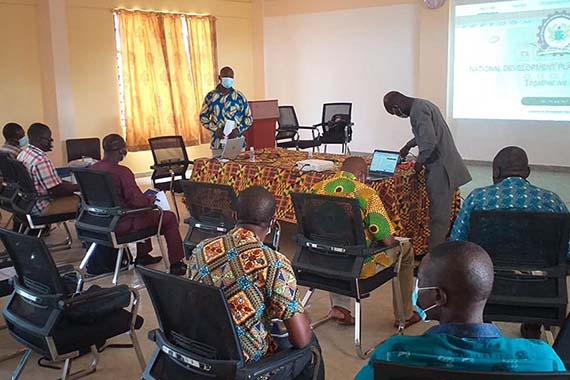
A training workshop facilitated by NDPC at the Bolgatanga East District Assembly
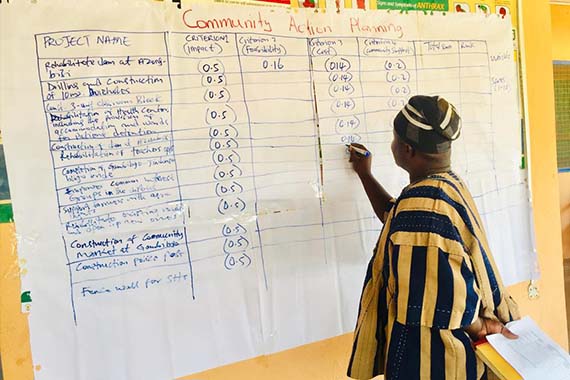
CAP development at Gambigo community
Introduction of Project!
In recent years, there has been a growing interest in promoting the use of evidence and data by public officials to inform policymaking and everyday decision-making processes. This interest is driven largely by dissatisfaction with government policies and programs that have failed to adequately address the persistent development challenges facing citizens and communities.
Governments routinely generate vast amounts of data through their operations, while researchers also produce valuable evidence, often with direct policy relevance. Together, these resources have the potential to improve policy outcomes and positively impact the lives of citizens, particularly the poor and vulnerable. However, policymakers have increasingly become less reliant on evidence and data in policy formulation, program design, and implementation. This has resulted in gaps between evidence generation and evidence use in addressing citizens’ needs.
Recognizing this challenge, the Ghana Center for Democratic Development (CDD-Ghana) partnered with a consortium of civil society organasations including TEERE to pilot an initiative aimed at strengthening the use of data and evidence in local government decision-making at the Bolgatanga East District Assembly. The project, known as Evidence for Development (E4D), started in July 2019 with funding from William and Flora Hewlett Foundation
ProjectOverview
The Evidence for Development (E4D) intervention was designed to strengthen the capacity of policy actors to access, analyse, and use policy-relevant data and evidence in decision-making. The overarching aim was to improve social development outcomes at the sub-national level in Ghana by embedding evidence-informed practices in governance.
To achieve this, the project pursued the following strategies:
- 1. Establishment of the Community of Practice (CoP) and enhance collaboration for data and evidence production and accessibility among diverse actors at both the national and subnational levels, including governmental and non-governmental institutions.
- 2. Building capacity and motivation of government policy actors particularly at the district level through targeted training programs, technical support, and relationship-building initiatives.
- 3. Creating incentives for policymakers to systematically integrate data and evidence into routine policy planning, program design, and implementation.
The long-term vision of the E4D intervention is to institutionalize the culture of data and evidence use in government policy planning, decision-making, and program implementation at the sub-national level. By doing so, the project aimed to contribute to more responsive, accountable, and development-oriented governance in Ghana.
Project Activities
The project significantly enhanced the capacity and motivation of diverse data and evidence-to-policy stakeholders to advance Evidence-Informed Decision-Making (EIDM) practices across districts. Key interventions included:
- Training workshops: Facilitated by CDD-Ghana and partners, these sessions created awareness of the EIDM approach to policymaking and improved the knowledge base of stakeholders.
- On-the-job training: Delivered by the National Development Planning Commission (NDPC) and district-level EIDM Communities of Practice (CoPs), this support deepened participants’ commitment and strengthened practical skills.
- Emergence of champions: The interventions nurtured a core group of champions—both within and outside government—who became instrumental in promoting and sustaining EIDM practices within the Bolgatanga East District Assembly and beyond.
- Community sensitisation: Radio programs were used to inform communities and encourage their active participation in the decision-making process.
These collective efforts resulted in tangible improvements in the Bolgatanga East District’s Medium-Term Development Policy Framework (2022–2025). The updated plan now reflects stronger evidence-based planning and has successfully mainstreamed EIDM action plans, developed through the CoPs, into the district’s official Medium-Term Development Plan (2022–2025).
Community Action Plan
A Community Action Plan (CAP) is a strategic roadmap developed by and for the community to guide local development efforts. The CoP engaged community residents to identify pressing needs, set clear goals, and design practical activities aimed at achieving positive and sustainable change. This participatory approach ensures that interventions are responsive to community priorities, build on existing strengths, and contribute to long-term social, economic, and environmental sustainability.
Peace Building
TEERE’s vision is to see communities take charge of their own affairs by strengthening their capacity to take active participation in matters affecting their lives. In as much as we roll out pro-poor intervention programmes to build the rural communities, we are faced with the threat of ethnic and chieftaincy conflicts, violent extremism, terrorism etc. in the Upper East region and the country at large.
Ghana, like many countries in Africa and beyond, faces the daunting task of effectively securing its borders amid rising threats of terrorism and violent extremism. The challenge is compounded by the existence of numerous unapproved border routes, limited logistics, and human resource constraints, which hinder the capacity of state institutions to manage and patrol these borders effectively.
The threat is no longer distant. Terrorist and extremist activities, which spread from North Africa and the Sahel, have already reached Ghana’s northern neighbour, Burkina Faso. The terrorist attack on August 18, 2021, is just one of many incidents that raise the risk of a spillover into Ghana’s border communities.
These security threats unfold within a volatile national context characterized by high youth unemployment, rising economic hardships, tribal tensions, and attacks involving nomadic herdsmen. Such conditions create fertile ground for radicalization and violence if left unaddressed.
A critical but often overlooked stakeholder in peacebuilding is the youth. Despite being at the forefront of most conflicts, young people remain excluded from the country’s security architecture and from traditional conflict-resolution spaces such as the chief’s palace. Without their inclusion, peacebuilding efforts risk being incomplete and unsustainable.
Our Approach
Peace is the foundation of sustainable development. The devastating impact of conflict in places such as Bawku demonstrates how quickly progress can be eroded when peace is absent. Peacebuilding, therefore, is not the responsibility of a few, but a collective duty that must be prioritized by all stakeholders.
TEERE is committed to ensuring that youth, who are often excluded from decision-making yet remain at the center of conflict dynamics, are properly represented in security governance at all levels. To this end, TEERE will advocate for inclusive structures that give young people a voice in shaping peace and security policies.
As part of its strategy, TEERE will work closely with security agencies to facilitate community engagement through the TEERE Local Government Forum (TLGF). This forum will provide a platform to engage directly with community members, enabling their concerns and insights to be documented. Key issues raised will then be escalated to regional forums or roundtable discussions and eventually consolidated into recommendations for submission to the National Security apparatus.
Furthermore, TEERE will leverage existing youth platforms to carry out sensitization campaigns. Selected youth leaders will be trained and empowered to work alongside assembly members and local leaders to spearhead awareness and peace education in their respective communities. Assembly members, in particular, will be equipped to serve as reliable contact points for reporting suspected acts of conflict, terrorism, or violent extremism. This information will then be relayed promptly to the security agencies for timely intervention.
Through these interventions, TEERE seeks to strengthen community resilience, enhance youth participation, and foster sustainable peace across Ghana’s border communities.
Donate Now

- Ministries Block, Box 373.
Bolgatanga, Upper East Region (UER),
Ghana. West Africa - +233 382-021-907
- +233 200-915-187
- info@teere.org.gh

About TEERE
TEERE started initially as a non-registered community mobilization organization. It provided remedial education, counseled youth on educational opportunities and facilitated the admission of many others. Starting 2011, it has been working with low-income...
Read more
Photo Gallery
Website powered by: TEERE IT - Department.