Our Success Stories
Home / Learning Center / Our Success Stories
LOCAL ECONOMIC DEVELOPMENT
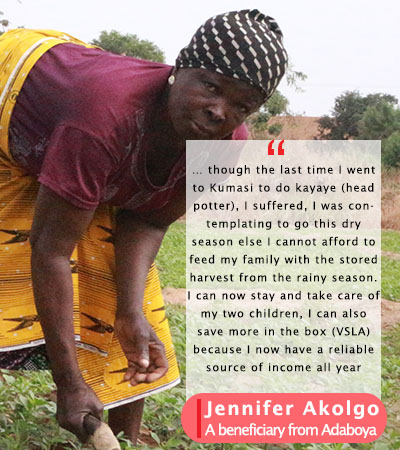
SMALL SCALE DRY SEASON FARMING IN THE BONGO DISTRICT OF UPPER EAST GHANA
The Bongo district is located in the Upper East Region of Ghana. The Bongo district like other districts in the region is faced with widespread poverty. In the savannah zone, this is due to the seasonal misfortune of having one rainy season in a year in a zone where the major occupation is farming. Of all groups, women suffer the most consequences of migrating to the southern part of Ghana during the dry season with the intention of gaining employment to feed their families. In their quest to sustain their families till the next rainy season, they get exploited and abused.
This project supported 50 dry season women farmers who belong to various village savings and loans associations in five localities in the district. 71% of these earned less than GH₵ 500 in a month which is woefully inadequate to cater for their big family size of more than 5 people which 74% of beneficiaries cater for. These harsh economic conditions have led the migration of family members of 83% of beneficiaries and many more were at the risk of migrating down south of Ghana.
TEERE’s dry season small scale project with a funding of GH₵ 50,000 from the German Embassy in Ghana provided farm inputs including water pumps and accessories to make water from dugouts and dams accessible, improved seeds, fertilizers, pesticides amongst others, trained women in modern agricultural practices and provided extension services in collaboration with the Bongo District Agriculture Department.
During the first cycle of harvest of various crops such as tomatoes, kenaf, beans and onions in the nine months long dry season, beneficiaries have made economic gains ranging from GH₵ 500 to GH₵ 1000. These women have also engaged other farm hands from their families hence mitigating migration due to lack of source of income in the dry season. Proceeds from the sale have also allowed the women to save more during this dry season as compared to previous ones.
GOOD LOCAL GOVERNANCE
TEERE LOCAL GOVERNMENT FORUM (TLGF I & II)
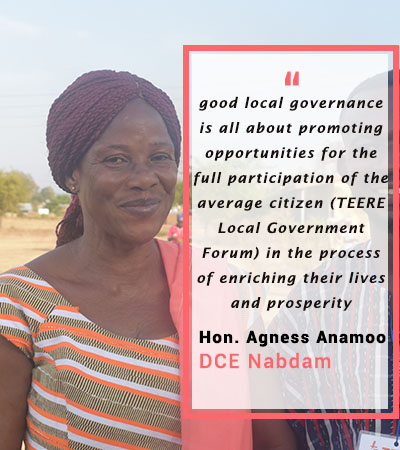
Development if meant to be effective and efficient must be pursued with the bottom–up approach especially in areas where there are so much development deficits and needs to be addressed to close the development gap between the citizenry. Though Ghana has made many strides in decentralization, pertinent issues such as the appointment of one-third of the representatives in the District General Assembly, the absence of financial independence from central government, limited informal forums of engaging duty bearers and no legal structures to incorporate critical local actors such as traditional actors in local development.
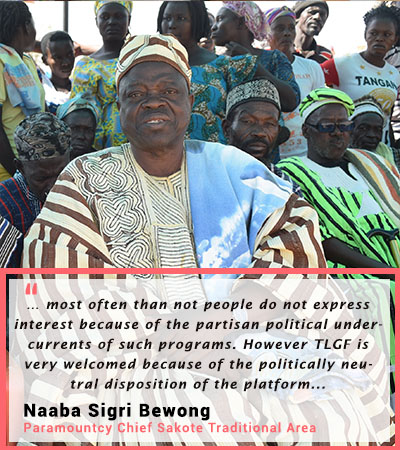
The TEERE Local Government Forum TLGF serves as a tool and an informal politically neutral platform to engage citizens at the local level to participate and generate discussions on development agenda. A critical role in the decentralization process to influence local governance policy and district development planning. Thus relevant actors such as traditional rulers, women, Persons with Disabilities, district planning officers and other core assembly staff meet on a common platform to deliberate on the development priorities of the district. This project so far organized at the community level (Zokko), district level (Bongo and Nabdam) and the regional level (Bolgatanga) has been sponsored by the Robert Bosch Stiftung with the sum of €40,050.00.
The project resulted in the donation of assorted medical items worth € 35,000.00 by the International Children Help organization upon hearing the outcry of the challenges mothers go through to get health services at the Bongo District Hospital for their wards. In both Nabdam and Bongo, District Planning Officers indicated the programme was an appropriate forum to appreciate the plight of the district which fed into the design of the District’s Medium Term Development Plans. Thus the peculiar needs and essential services of the people in these districts are the determinants of their Medium Term Development Plans which is implemented annually.
GOOD LOCAL GOVERNANCE
PROMOTING ACCOUNTABILITY IN THE MANAGEMENT AND DISBURSEMENT OF 2% DISTRICT ASSEMBLY COMMON FUND ALLOCATED TO PERSONS WITH DISABILITY.
The 2% of the District Assembly Common Fund allocated to the Persons with Disability has not achieved its intended purpose. The common fund newsletter published in December, 2014 indicated that “there are serious problems with the management, disbursement, utilization, and accountability of the 2% (now 3%) allocation in almost all the MMDAs…” These Problems include district Assemblies persistently borrowing from the fund, financial management and disbursement structures to ensure accountability and transparency are not effective, both managers of the fund and beneficiaries lack knowledge on the Provisions of the guidelines for the disbursement and management of the fund, weak monitoring of funds utilization by mandated institutions and lack of advocacy skills among the leadership of PWDs to demand for accountability.
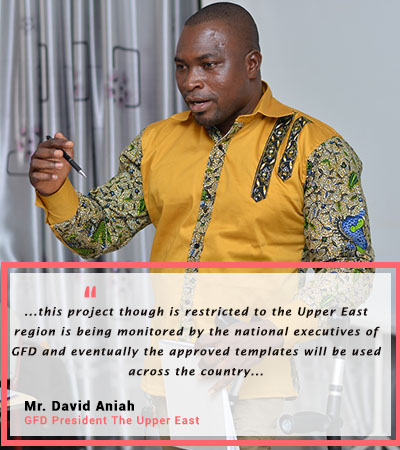
TEERE in partnership with Ghana Federation of Disability Organizations Upper East Chapter (GFD-UER) and with funding of €23,228.00 from the French Embassy in Ghana sought to improve on the functioning of the fund in 7 districts in the Upper East Region. The project sought to enhance the knowledge of the beneficiaries on the guidelines for disbursement and management of the fund, strengthen transparency and accountability, ensure justice for all beneficiaries through transparent and well communicated criteria for the selection of beneficiaries as well as harness the fund for the socio-economic development of beneficiaries.
TEERE with the GFD-UER conducted a performance appraisal of all beneficiaries of the fund in the seven districts. The findings from the performance appraisal confirmed the stated problems in the fund management. TEERE and GFD-UER trained stakeholders such as core assembly staff, leadership of disability organisations and members of the Disability Fund Management Committee on the disability fund management and disbursement guide that regulates the fund. Having been trained, all these stakeholders drafted a uniform application, monitoring and reporting templates to enhance and ensure transparency, accountability and the proper administration of the fund. For the beneficiaries, the project has established VSLA groups to improve their culture of saving, social cohesion, develop the concept of self-help amongst the disabled communities. Development if meant to be effective and efficient must be pursued with the bottom–up approach especially in areas where there are so much development deficits and needs to be addressed to close the development gap between the citizenry. Though Ghana has made many strides in decentralization, pertinent issues such as the appointment of one-third of the representatives in the District General Assembly, the absence of financial independence from central government, limited informal forums of engaging duty bearers and no legal structures to incorporate critical local actors such as traditional actors in local development.
WOMEN AND YOUTH EMPOWERMENT
TEERE VILLAGE SAVINGS AND LOANS ASSOCIATIONS (VSLAs).
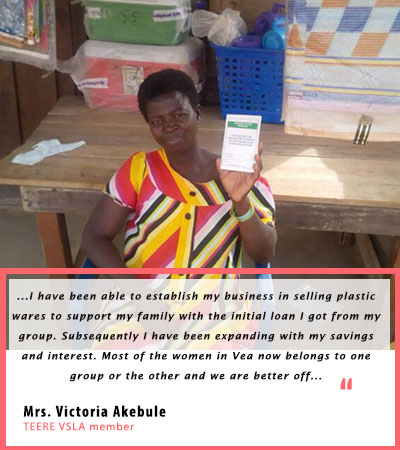
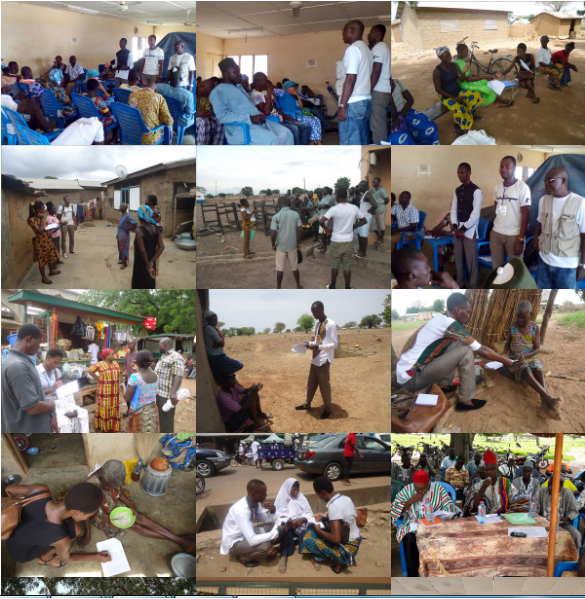
TEERE has formed, trained and monitored over 250 VSLA groups in the Bongo, Bolgatanga and Talensi districts in the Upper East region. These 250 groups average about 6,250 beneficiaries of which over 80% are women involved in small holder farming, craft or petty trading. TEERE mobilizes these women, train, provide equipment and monitor their progress and seeks for eternal support to these groups. These are groups of women who contribute their resources, give out loans with little interest to group members and share interest accrued at the end of each cycle.
TEERE over the years has developed manuals and templates to facilitate its operationalization of VSLAs as well as has developed innovative training methods that suit both its educated and uneducated beneficiaries. There are also existing policies on share purchase and lending that groups adopt and modify to suite their preference. TEERE also has template constitutions that are adopted and modified to fit the collective interest of groups. TEERE has adopted the VSL Associates’ VSLA toolkit that allows for collecting holistic data on VSLAs including membership, share purchases, loans disbursement and loans repayment. This software toolkit is a major means of tracking progress, monitoring and evaluation.
TEERE offers additional training to beneficiaries in areas of personal financial management, essential skills for income generating activities and other areas of capacity building as deemed fit in consultation with the various VSLA groups. The VSLA has brought financial services to their door step, built leadership and management skills among the women as the groups are purely manage by themselves
This project has been of tremendous benefit to comparatively disadvantaged women with limited access to farmland and financial resources. This has opened employment opportunities for women as they could mobilize more resources to cultivate their farms especially in the lean season. This has promoted gender parity in access to financial resources and employment opportunities for women whiles demonstrating to men the importance of VSLAs in resource mobilization.
Donate Now
TEERE needs your support in other to achieve its goal "An Autonomous local government system based on the rule of law, Ghanaian culture and tradition."

- Ministries Block, Box 373.
Bolgatanga, Upper East Region (UER),
Ghana. West Africa - +233 382-021-907
- +233 200-915-187
- info@teere.org.gh

About TEERE
TEERE started initially as a non-registered community mobilization organization. It provided remedial education, counseled youth on educational opportunities and facilitated the admission of many others. Starting 2011, it has been working with low-income...
Read more
Photo Gallery
Copyright © 2016 - 2019 teeregh.com. All rights reserved.
Website powered by: TEERE IT - Department.
Website powered by: TEERE IT - Department.